Sales Decline in Indonesia Draws Attention from Toyota Japan
01 February 2026, 13:00 WIB
The Ministry of Industry believes the condition of the automotive industry cannot be assessed solely based on growth in one segment.


By Adi Hidayat
KatadataOTO – The Ministry of Industry revealed that the assumption by some that the automotive industry is in a strong condition is wrong. This is because overall vehicle sales data shows the opposite.
Febri Hendri Antoni Arif, spokesperson for the Ministry of Industry, revealed that EV sales have indeed increased significantly. However, in the period from October 2024 to January 2025, sales were mostly supported by CBU EV imports.
In fact, of the total EV sales from January to October 2025, 73 percent were imports. Thus, the added value and labor absorption of the industry are in other countries.
Meanwhile, the domestically produced vehicle segment, which has the largest market share, has experienced a significant decline. Therefore, according to him, it is wrong to state that the automotive industry is in a strong condition by only relying on growth indicators in certain segments.
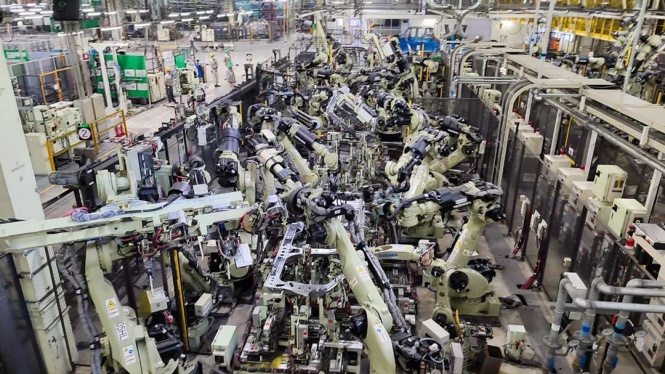
"The sharp decline in car sales, far below production figures, while imported EV sales are rising sharply is a fact. This must be an indicator of the national automotive industry's growth, and we believe incentives are needed to reverse this situation," he stressed, as reported by Antara.
He also assessed that the large number of exhibitions does not mean the automotive industry is strong. The strength of the national automotive industry can only be concluded based on sales and production data.
"Many exhibitions are an effort by the industry to survive amidst plummeting sales. We must use existing statistical data to describe the objective condition of the automotive industry and not use the number of automotive events," Febri added.
The Ministry of Industry emphasizes that the most fundamental indicator for measuring the health of the automotive industry is vehicle sales to the market, not just the growth of certain segments or the size of investments.
Based on Gaikindo data, car wholesales from January-October 2025 were only 634,844 units. That figure is down 10.6 percent compared to last year, which reached 711,064 units.
Meanwhile, retail sales (sales from dealers to consumers) were recorded at 660,659 units from January-October 2025. That figure is down 9.6 percent from last year, which reached 731,113 units.
Therefore, the Ministry of Industry asserts that automotive incentives are a crucial instrument in efforts to recover the market.
"Although the Ministry of Industry has not yet formulated the type, form, and target of the incentives, the proposal will be directed towards the lower-middle class segment and based on the TKDN (Domestic Component Level) value," he said
Related Articles
01 February 2026, 13:00 WIB
01 February 2026, 11:00 WIB
31 January 2026, 17:00 WIB
29 January 2026, 12:00 WIB
28 January 2026, 11:00 WIB
Latest
02 February 2026, 10:00 WIB
Sales are trailing competitors, and MG declined to elaborate on its sales target for 2026.
02 February 2026, 09:00 WIB
Chery hybrid cars offer more benefits to consumers in Indonesia, making them a popular choice.
02 February 2026, 08:00 WIB
The Police launched Operation Keselamatan Jaya 2026 to curb the number of accidents and traffic violations on the roads.
02 February 2026, 07:00 WIB
Yamaha is confident that the target set by AISI can be achieved this year, with several conditions.
01 February 2026, 17:17 WIB
Toyota FT 86, Vespa Corsa 125, and Toyota Alphard are three of Reza Arap's many vehicles.
01 February 2026, 15:00 WIB
Shell, BP AKR, and Vivo lowered fuel prices for the February 2026 period by varying amounts.
01 February 2026, 13:00 WIB
Toyota Motor Corporation is paying closer attention to its sales in Indonesia, which have significantly declined.
01 February 2026, 11:00 WIB
Toyota group sales break a new record and become the world's best-selling manufacturer in 2025, surpassing Volkswagen.