Tesla Model S and X Production Halted, Elon Musk Opts to Build Robots
01 February 2026, 09:00 WIB
The government is considered to need to further clarify the regulations concerning the Domestic Content Level (TKDN) for imported electric vehicles re


KatadataOTO – The Domestic Component Level (TKDN) regulations for electric cars are currently considered not strict enough. Various manufacturers are said to have not yet utilized local component suppliers.
It should be noted that in 2026, manufacturers receiving incentives for imported Electric Vehicles (EVs) are required to conduct local assembly corresponding to the number of sold units brought into Indonesia completely built-up.
However, the Association of Indonesian Automotive Parts and Components Industries or GIAMM highlights that the regulations regarding local assembly are still not strict enough.
It was explained that the Completely Knocked Down (CKD) procedure itself already contributes 30 percent to the TKDN. Meanwhile, the minimum requirement that each manufacturer must meet is 40 percent.
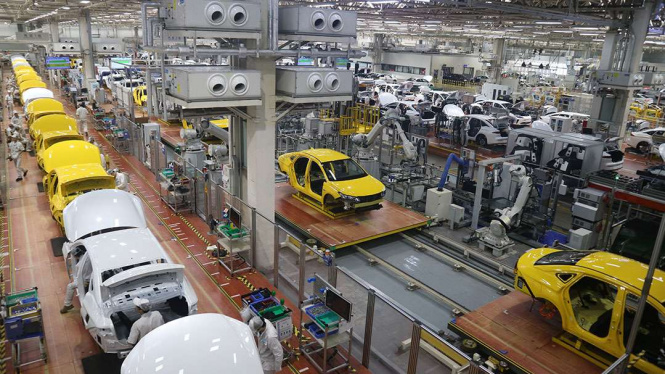
As a result, various manufacturers receiving incentives for imported electric cars have not maximized localization as expected.
GIAMM hopes the government can pay attention to this policy so that the domestic component industry can also be helped.
Considering that for three consecutive years, GIAMM revealed that the component industry has faced many challenges and declines.
“For electric cars, the government is also strongly encouraged to start localization, utilizing the existing domestic parts or component industries,” said Rachmat Basuki, Secretary General of GIAMM to KatadataOTO, on Tuesday (30/12).
According to Rachmat, the list of manufacturers required to conduct local assembly next year has not yet utilized domestic components.
In fact, the incentive policy is expected to be able to revitalize the component industry in 2026 after a decline due to the onslaught of imports.
“Domestically assembled electric cars have not yet implemented localization,” Rachmat emphasized.
The first manufacturer to benefit from the imported electric car incentive is BYD. Thanks to this subsidy, the price of BYD EVs is considered competitive despite their Completely Built Up (CBU) status.

Next is Citroen. This brand had imported a number of Citroen e-C3 electric car units completely built-up before then assembling them locally at the facility owned by Indomobil Group, National Assemblers.
After BYD and Citroen, other Chinese brands followed suit. There are GAC, Geely, and Xpeng, and then the manufacturer from Vietnam, VinFast.
All of them are required to assemble their vehicle lines in Indonesia starting in 2026, corresponding to the number of imported units delivered to consumers while receiving the incentives.
Related Articles
01 February 2026, 09:00 WIB
31 January 2026, 19:00 WIB
31 January 2026, 15:00 WIB
30 January 2026, 18:00 WIB
30 January 2026, 13:00 WIB
Latest
02 February 2026, 10:00 WIB
Sales are trailing competitors, and MG declined to elaborate on its sales target for 2026.
02 February 2026, 09:00 WIB
Chery hybrid cars offer more benefits to consumers in Indonesia, making them a popular choice.
02 February 2026, 08:00 WIB
The Police launched Operation Keselamatan Jaya 2026 to curb the number of accidents and traffic violations on the roads.
02 February 2026, 07:00 WIB
Yamaha is confident that the target set by AISI can be achieved this year, with several conditions.
01 February 2026, 17:17 WIB
Toyota FT 86, Vespa Corsa 125, and Toyota Alphard are three of Reza Arap's many vehicles.
01 February 2026, 15:00 WIB
Shell, BP AKR, and Vivo lowered fuel prices for the February 2026 period by varying amounts.
01 February 2026, 13:00 WIB
Toyota Motor Corporation is paying closer attention to its sales in Indonesia, which have significantly declined.
01 February 2026, 11:00 WIB
Toyota group sales break a new record and become the world's best-selling manufacturer in 2025, surpassing Volkswagen.